Welcome to the Calvacade of Magic Presented By Kirk Kirkham

My Father was the Magician known professionally as Kirk Kirkham, his real name was Charles and many folks called him Chuck. He lived from 1926 to 2001. He was an active professional performer from the time he was sixteen years old. Magic was the only living he ever had. He toured with the USO after World War II, did the spook show circuit and television extensively in the 1950's, did thousands of club dates, school shows, and more television in the 60's, continued performing in the 70's but also became a well regarded prop maker who produced equipment for other magicians and attractions around the country.

Currently, David Copperfield has the largest private collection of illusions in the world, but prior to his success and collection, my father may very well have been the previous holder of that title. He owned parts of Thurston's Wonder Show of the Universe and Mysteries of India. He acquired much of the core of his collection from Will Rock back in the early 50's but continued to add to it the rest of his life. He knew and worked with Harry Blackstone Sr., Percy Abbot was a mentor to him. Dante was a personal friend, and he owned famous illusions that belonged to all of them.

My goal is to keep his legacy alive here in cyber space, and provide some historical context to the Southern California Magic scene in the 60's and 70's. I have had virtually no contact with the Magic world since my Mother passed away in 1994. My Dad suffered from Alzheimer's in his last years and he could not write the book that he always said he would get to someday. I don't know enough about magic to write competently concerning history, practice and technique. I can however provide an historical context for my Father, a man who knew almost everything about magic during the 20th Century. He had a huge library, subscribed to dozens of magazines, and had met every important magician of the second half of the century. He was consulted by many of the experts that now make up the intelligentsia of the magic community. He was also a mentor to many fine magicians and scholars of magic. I hope to hear from some of those people as a result of this blog.

Welcome to the Magical World of Kirk Kirkham.

Wednesday, December 14, 2011

Ice Capades 1984

Originally my Dad had created a Magic segment for the Ice Capades back in 1976. That was the year of the Bicentennial and the Dorothy Hamill Winter Olympics. After she had competed for and won the Gold Medal in the Winter Games, she joined the Ice Capades show and when we were back in Atlantic City during the Summer Rehearsals, we got to meet her backstage. My Dad worked with the show for a few days while my Mom, Little Brother and I did some tourist type things. I barely remember the props that we produced for this show. When I come across the pictures I will post them. Eight years later however, Ice Capades came back and asked Dad to produce a more elaborate segment. We would recondition some of the original props but also add several new spectacular illusions to this part of the show. The theme would be Asian/Chinese and the props were designed to fit with this color scheme and design.

I was married at this point and I was teaching at Cal State Northridge and Fullerton College, but I did not have any summer classes and I needed to work. Dad always asked me to help him and I was glad to do it, but this year I needed to be paid more substantially. He agreed, but expected me to treat it like a daily job (without weekends off). So every day from late May until late July, I spent most of the day working with him on this project. The truth is, most days were pretty smooth and easy. I'd come up to my folks apartment, have breakfast with Mom and Dad, and we would map out the day. Some days we had to go in search of hardware, some days were dedicated to design and planning, and other days we were acquiring materials to put it all together. At lunch we would walk across the street from the warehouse that formerly held Owens Magic Supreme, to the Pup n' Taco, and get good cheap food. If it was hot, and we had been doing more intense manual labor, we would cruise down Valley Blvd. a few blocks and eat at Bob's Big Boy, getting a traditional double decker burger with the red relish and maybe a chocolate shake. There were a lot of pictures drawn on napkins at Bob's as we planned the props looks.

The segment would open with several skaters escorting a fancy rickshaw out onto the center ice. Seated on the rickshaw would be the performer playing the part of the Chinese Magician. He would step off the rickshaw and skate out on the ice with a net that he then used to catch doves out of thin air with. The doves would appear in the net and then be slammed into cages carried by other skaters. Then the doves would be placed in an ornate box which was spun around and opened, collapsing on all sides revealing a large duck.

These props were part of the original 1976 show, where they were black and silver with a very modern theme. We did not have to start over but the gimmicks needed to be refurbished or replaced and everything had to be repainted to fit with the new theme.

The "Magician Skater" (Ice Capades Star David Sadleir) then turned back to the empty rickshaw and had it pulled out to the center ice, he closes a privacy curtain around the seat for a very brief moment and then whips it to the other side, revealing a beautiful skater dressed in traditional Chinese garb of red silk. She has appeared from nowhere and now will be featured in the remainder of the act.

Here is the rickshaw as it appears from the beginning of the scene.

That is me pulling the rickshaw and seated in the spot that would be originally occupied by the magician and where the assistant would appear moments later is my Dad's friend Ed Linde. He worked with us many times that summer and was one of the sweetest guys in the world. He was the projectionist at the Vogue and Pacific theaters on Hollywood Blvd. I know he had worked for the theater chain for several years because he got our whole family into one of the early screenings of 2001:A Space Odyssey back in 1968. He was another amateur magician that knew how to do a lot of little magic illusions in close up but was not really a seasoned performer. I remember how nervous he was when he auditioned for his Magic Castle membership. Here is a shot of the rickshaw with the curtain closed.

To be able to get the curtain to quickly close and just as quickly flash open to reveal the assistant, we came up with the idea of using the same type of curtain rails that are used in hospitals for their privacy curtains. I have a pretty strong memory that this was one of my ideas. Finding supplies like that was not easy. We ended up at a manufacturing firm in the Burbank/North Hollywood area. We only needed a dozen feet of rail or so, and they did not deal in orders that small. They let us have some remnants for about ten bucks, and they also had the hardware for the runners. That trip was a whole afternoon and there were always small side projects to deal with as part of the bigger process.

The "Magician Skater" would then work with his assistant and produce four other skaters dressed in old style Chinese wardrobe as well. This involved the use of a production cabinet which is brought out center ice and spun around while open to reveal to the audience that it was empty. The "Magician would enter, with a foulard draped over his arm, close the curtains and then open them suddenly, holding the corners of the foulard as a figure emerges onto the ice, covered. The process is repeated three more times, each time the cabinet is shown empty and each time a new figure emerges covered by a beautiful Chinese silk cloth. The magician claps his hands and the figures spring up, throwing off their covers and revealing four skaters in elaborate costume.


When I find the series of pictures from the actual show, I will add a slide show so you can get some idea of the effect. The pictures that I know I have were taken from high in the stands and in the dark of a performance. They are not as clear and sharp as the images here. This post is primarily about the construction of the project rather than the performance.


The four skaters that have appeared, now become additional assistants in the act. Two of them skate off to the rear of the ice and roll out a short flat box with a temple style roof on it. A cable is attached and the roof is raised about six feet. It is connected to the base by four chains that hang down and connect to the base. This created an empty rectangular box. Before the box is hoisted into the air, a four sided curtain is raised to the roof from the base and attached there, then the whole piece is raised forty to fifty feet in the air.
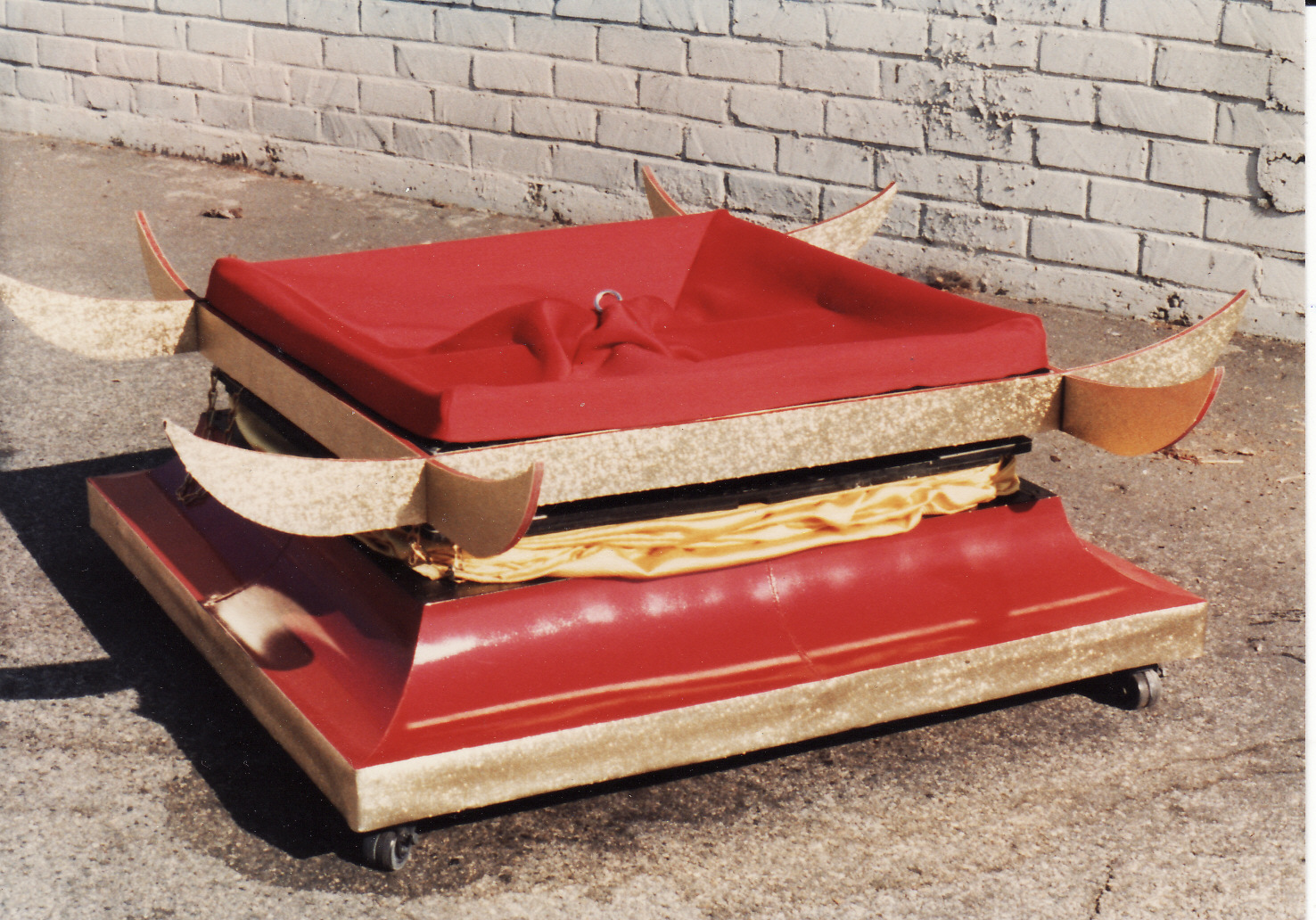

The whole idea of this pagoda shaped illusion came from a dinner we had one night at a Chinese Restaurant. At the back of the table in the booth we sat in was a seven inch high, four sided pagoda that contained a liquor ad on the cardboard sides. The top and bottom of the pagoda display were separate plastic pieces that fit onto the cardboard square. The effect of the curtain replaces the booze ad in the magic prop.


The production cabinet was a refurbishing job from the 1976 show, but the pagoda appearance, like the rickshaw was designed for this new segment. While two of the skaters and the magician are preparing the pagoda to be raised, the other two skaters from the production cabinet roll out a giant canon onto the ice. As the pagoda is raised in place, the "Magician" loads the canon with the beautiful girl that appeared on the rickshaw.


This canon was one of the props I was most proud of playing a part in designing and building. This canon is different from almost every other canon illusion used in magic shows in a couple of ways. First, it is made of metal, not wood or plastic. It looks like it could actually be a canon and not just set decoration. The other truly distinctive part is that the barrel of the canon is tapered like a real canon would be. This was designed by my father but actually fabricated by a metal work shop in Monterey Park. He had worked for my Dad before, building gimmicks for levitations and swords for various other props. This job cost three times as much as my Dad had expected. It was quite a strain because it cut down the profit margin on the whole project. I told him that cost overruns are often borne not by the contractor alone but also by the client. Although he was loathe to do it, I think he did end up asking for additional fees from the Ice Capades. I have no doubt it was a minor cost to them, although it was a big deal to us. My Dad hated to be wrong in his price estimates to customers. Unlike a certain magic manufacturer in the area at the time, he did not base his price on assessing the customers financial ability to pay, but rather on the actual work involved.

The canon is then pointed at the hanging pagoda and it is fired. In an instant, the canon bursts open to show that the girl is not there and at the same moment, the curtain on the pagoda hanging many feet up in the air drops and reveals the girl now standing in the chain framed pagoda. This is the climax of the act and brings to a close the Magic segment of the Ice Capades.

Here you can see the canon in it's open position after the girl was loaded in the front and the canon was fired. The firing triggered the canon to split open confirming that the girl had been magically fired up in the air to her position standing in the floating pagoda.

By the way, that is Ed Linde's bronze Cadillac in the background of the picture, taken outside in the parking lot next to the warehouse.

All of these props had to be constructed to be broken down for transport and reassembled at the new venue. They had to be sturdy because they were used a dozen times a week for a whole season which is basically a year long. Then the equipment moved to a second troop of skaters working a different circuit under the same conditions. My Dad had to travel a couple of times to restore and or fix something that could not be taken care of by the touring prop department. I have no idea what happened to these props, I hope that someone is still getting some use and pleasure out of them somewhere in the world.

Friday, December 9, 2011

Magic Shop Visitors

My Dad always liked the idea of owning his own magic shop. In the 1960s, he leased office space in the building across the street from Joe Bergs and Hollywood Magic. Up in the fourth or fifth floor, he had a shop that was by appointment only. He did not cater to walk in or tourists. He was interested in working with and talking to professionals. A magic shop had always been like a clubhouse to him. It was where people interested in the same thing could find each other and engage in conversation, business and demonstration all at once. Because he had a large collection of props, many of which were valuable and one of a kind, he also liked to show off a little.

For five or six years, from about 1982 to 1988, he occupied a warehouse in Alhambra that was formerly a garage in the 1930s and 40s, but had been the home of Owen Brothers Magic Manufacturing Company in the 50s and 60s. After Les Smith moved the Owen Company to Azusa, the warehouse was occupied for a short time by a magician whose name i remember as being Carl Beck. He actually kept a black panther that he used in his act in one of the old service pits below the floor level. My Dad managed to get the lease when he left and set up his own manufacturing business there. He also created a foyer area that he used as a magic shop meeting area. Many of his friends would come and spend hours hanging out there exchanging stories and ideas. One of the magicians he knew was being sponsored in part by a well know sports figure. He and his sponsor came and spent the day at my Dad's place. In the picture below you will see the young magician, Lou Lancaster who was a close friend of my Dad, The Greatest Himself, and my little brother Kirk.


Just as an addendum, you can tell my Dad was a pretty good photographer, he took the first picture which is really nice, but the shot he is in, part of his head is cut off.

Death Basket of India Manufacured


This is the version of the Hindu Basket Trick that my Dad made in the late 1970 or early 1980s. As you can see, it is not really a basket at all, but rather an angled box with a rattan facade. The swords were made with aluminum and the handles were formed using a plastic process that my Dad's friend Mark Gregory had developed. They used the same material to make disecto arm choppers and die boxes and a coin penetration box for close up magic.

I disliked the idea of a faux basket, but as I recall there were problems finding an actual basket and the magician that wanted this needed something sturdy that they could use to hold other props as they took it on the road. Dad was not am artist, but he did have an eye for detail and the paint job on most of his work was exemplary. The bamboo style legs here are really a creative application of spray paint and lacquer.

Wednesday, December 7, 2011

You Asked For It --Death Basket of India


This is a performance of the Hindu Basket Trick that we always referred to as the "Death Basket of India". This was one of the Thurston Props my Dad acquired from Will Rock. We used it for big stage shows when there would be a switch and a boy would pop out after the girl had been skewered. In the late 1960s and early 70s I was the boy. The show we did at the PCAM convention 1n Santa Barbara in 1968 also featured an appearance by "Robin" from the Batman TV Show. It was actually Peter Pit, a well known magician in a costume that he had. Somewhere I have a picture of that and I will add it to the post when I come across it again.

Most of the time we used a smaller basket and there was not a switch. Instead, my Dad would step inside the basket and occupy the space to show it was empty. Then, he would stand, cover the basket with a foulard, and a figure would rise, the girl reappeared. I no longer have either prop. The large basket went to the Robert Houdin Museum in Paris, which has apparently disappeared. I am not sure who my Dad sold the small basket to. We did manufacture a simulated basket prop for someone in the 1970's, but the ones we used were always woven baskets. Here is a shot of my older brother Chris with the basket we used on stage for club dates and smaller shows.


This clip is from "You Asked For It", a popular show in the 1950's. My parents performed on the show at least a half dozen times. Art Baker, the producer also used them on a variety of TV projects over the years.

Los Magicos

Los Magicos was the Hollywood Chapter of the Pacific Coast Association of Magicians, a regional magic club. Like the SAM and IBM counter parts, the primary purpose of the clubs was social and professional ties. The PCAM had periodic conventions and my dad performed for those shows several times. In 1968, there was a show in Santa Barbara that we worked that was pretty spectacular. I came across these rosters in some of my Dad's notebooks. Since they are all fifty years old now, I don't imagine anyone's privacy is being invaded. Many of the names on these lists were good friends of my Dad, and we saw them at the house on a regular basis. Joe Berg, who owned the Magic Shop above Hollywood Blvd. was someone I recall fondly, my Dad later


bought the title to the National Magic Company, which Joe Berg had owned as well. I love the prefix listings for the phone numbers. Most people today have no idea that letters were used to suggest the exchange for the phone service that you were located at.

Sunday, December 4, 2011

First Professional Show 1943


As you can see, this was a promo flyer for an evening show at a local school in 1943. My Dad would have been 17 for this performance. I have some photos that I think might be from that show, I will scan them in the future and add them to the post. My mother is listed as the featured assistant, the guys helping out were my Dad's two best friends in high school. Gene Griffith's brother Virgil died in Europe a little over a year later in the War.I have a notice of that from the local paper that my Dad held onto for the rest of his life.

Charles and Phyllis as they Started Out


My parents came out to California from their hometown of Battle Creek Michigan. Those of you old enough will recognize right away that Battle Creek is the home of Kellog's Cereal. My Grandfather (my Mother's Father) was one of the head maintenance/equipment engineers at the factory there. They had performed together since they were high school sweethearts. My father spent two years in the Army during World War Two. He was a paratrooper deployed in the Philippines. During the occupation of Japan, he was in Special Services and performed for the occupying forces. He was perhaps the first American Magician to perform in Japan after the war.

When he returned stateside, he spent several months working in the Harry Blackstone show touring the country. My parents married in July of 1947, and my mother was part of the act permanently. They had these shots taken not long after they got to Southern California, maybe 1949 or 1950. She was the floating lady, the divided lady and a general all around box jumper for most of their career. I'm sure they would have been happy had I been born a girl, my Father's onstage work could have continued longer if we'd had a female assistant at the ready. When my mom got older, it was a little difficult for her to jump out of the substitution trunk every night. By her early fifties she was semi-retired to the role of prop delivery and side kick. When she died in 1994, they had been married 47 years. As you can see, they were an amazing looking couple.

I just watched White Christmas on TV and was reminded of all the glamorous nightclubs that once ruled the entertainment world. The way my folks are dressed in these shots shows how much a part of that post war environment really did exist. Performers dressed in fabulous clothes and worked in some pretty great places as well as some dumps. They always classed up whatever joint they performed in.